
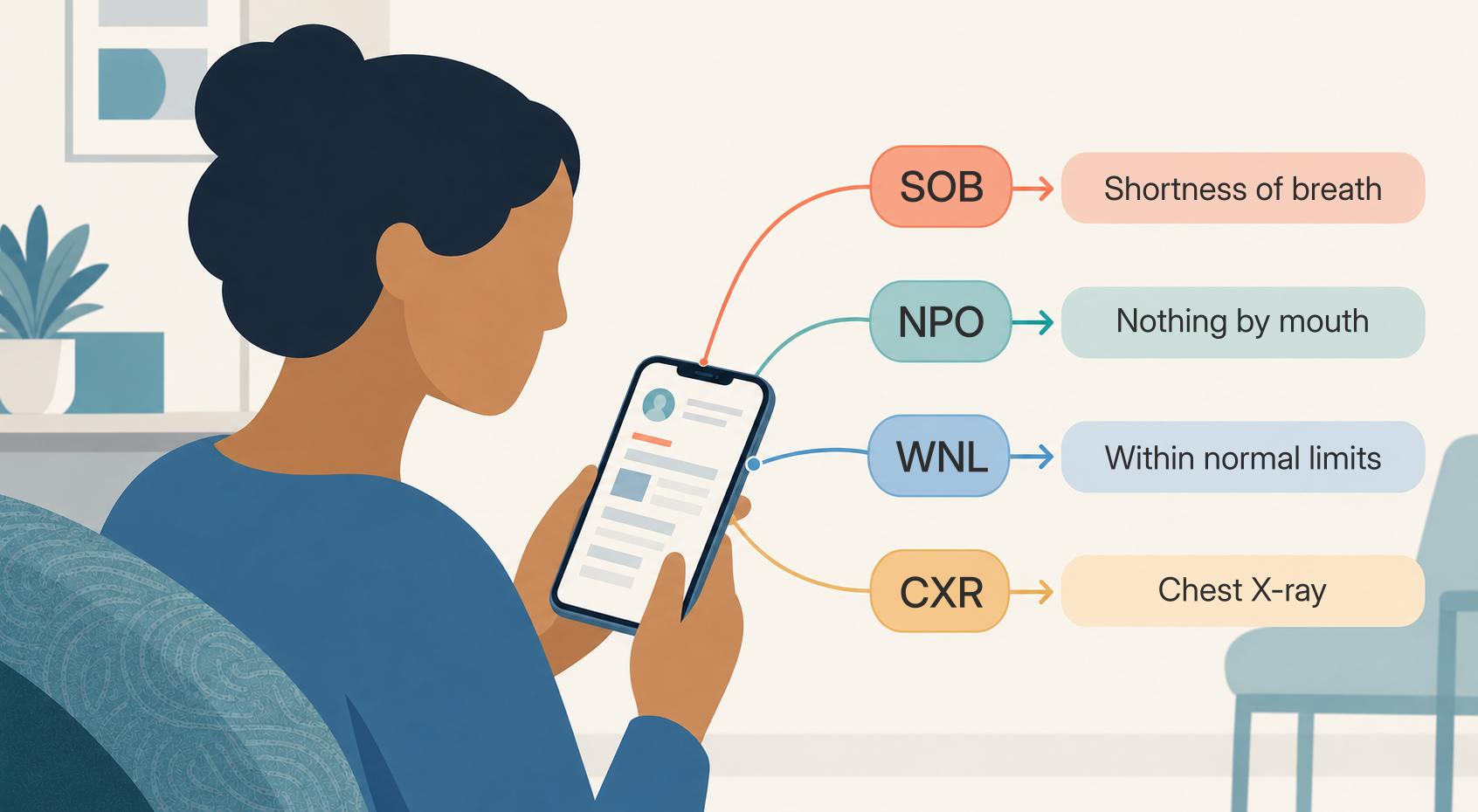
Emergency departments have their own language. Some terms are ordinary medical shorthand. Others describe how the department works, where you are going, or what happens next.
This guide translates common ER words, abbreviations, and phrases into plain English. The exact terminology varies between hospitals, and hearing or reading one of these terms does not necessarily tell you how serious a particular situation is.
Looking for a specific term? Use “Find in Page” in your browser menu, or press Ctrl+F (Command+F on a Mac).
Common Abbreviations
Healthcare workers use abbreviations to communicate quickly. You may hear these spoken aloud or see them in your medical record, test results, or discharge paperwork.
- A&O
- Alert and oriented. A description of a person’s awareness of who and where they are, the date or time, and sometimes the current situation. You may see “A&O x3” or “A&O x4.”
- ABC
- Airway, breathing, and circulation. The first priorities when evaluating and treating a critically ill patient.
- ACS
- Acute coronary syndrome. A group of conditions caused by reduced blood flow to the heart, including heart attacks.
- AMS
- Altered mental status. A change in thinking, awareness, behavior, memory, or level of alertness.
- BIBA
- Brought in by ambulance.
- BP
- Blood pressure.
- CBC
- Complete blood count. A blood test measuring white blood cells, red blood cells, hemoglobin, hematocrit, and platelets.
- CMP
- Comprehensive metabolic panel. A blood test that includes electrolytes, kidney-function measurements, glucose, liver-related tests, and proteins.
- CP
- Chest pain.
- CPR
- Cardiopulmonary resuscitation. Emergency measures, including chest compressions, used when the heart has stopped.
- CT
- Computed tomography. A detailed imaging test that uses X-rays and computer processing.
- CTA
- Computed tomography angiography. A CT scan timed with IV contrast to evaluate blood vessels or blood flow.
- CTPA or CTPE
- CT pulmonary angiography, sometimes called a CT pulmonary embolism study or protocol. A CT scan timed with IV contrast to look for blood clots in the pulmonary arteries.
- CVA
- Cerebrovascular accident. An older medical term for a stroke that may still appear in medical records.
- CXR
- Chest X-ray.
- DVT
- Deep vein thrombosis. A blood clot in a deep vein, usually in the leg.
- ECG or EKG
- Electrocardiogram. A test that records the electrical activity of the heart. ECG and EKG mean the same thing.
- ED
- Emergency department. The formal medical term for the ER.
- EMS
- Emergency medical services. Ambulance and other prehospital medical care.
- ER
- Emergency room. The familiar everyday term for the emergency department.
- EtOH
- Alcohol. The abbreviation comes from the chemical name ethanol.
- GCS
- Glasgow Coma Scale. A scoring system used to describe a person’s level of consciousness and responsiveness.
- GI
- Gastrointestinal. Relating to the stomach, intestines, and digestive system.
- GU
- Genitourinary. Relating to the urinary and reproductive systems.
- HA
- Headache.
- HI
- Homicidal ideation. Thoughts of harming or killing another person.
- Hx
- History. This may refer to the history of the current problem or a person’s past medical history.
- ICU
- Intensive care unit. A hospital area for patients who need close monitoring, advanced treatment, or life-supporting therapies.
- IM
- Intramuscular. A medication injected into a muscle.
- IV
- Intravenous. A catheter placed into a vein, or a medication or fluid given through that catheter.
- LMP
- Last menstrual period. The first day of the most recent menstrual period.
- LOC
- Loss of consciousness or level of consciousness, depending on context.
- MRI
- Magnetic resonance imaging. An imaging test that uses a strong magnetic field and radio waves rather than X-rays.
- MVC
- Motor vehicle collision.
- N/V/D
- Nausea, vomiting, and diarrhea. The letters may also appear separately, such as N/V for nausea and vomiting.
- NAD
- No acute distress. A charting phrase meaning the patient was not showing obvious severe distress at the time of the examination.
- NPO
- Nothing by mouth. A patient may be asked not to eat or drink because of testing, sedation, surgery, or concern about vomiting.
- O2
- Oxygen.
- PA
- Physician assistant. A licensed clinician who evaluates, diagnoses, and treats patients as part of the medical team.
- PCT
- Patient care technician. A staff member who may assist with vital signs, blood draws, ECGs, splints, transportation, and other care tasks.
- PE
- Pulmonary embolism, meaning a blood clot in the lungs. In some notes, PE may instead mean physical examination, so context matters.
- PO
- By mouth.
- PRN
- As needed rather than on a fixed schedule.
- R/O
- Rule out. A condition being considered and evaluated, not necessarily the most likely diagnosis.
- RN
- Registered nurse.
- ROM
- Range of motion.
- S/P
- Status post. A phrase meaning that something happened previously, such as “status post surgery.”
- SI
- Suicidal ideation. Thoughts about ending one’s own life.
- SOB
- Shortness of breath.
- SpO2
- Oxygen saturation, usually measured with a sensor placed on a finger.
- TIA
- Transient ischemic attack. Temporary neurologic symptoms caused by interrupted blood flow to part of the brain. A TIA requires urgent medical evaluation even if the symptoms have resolved.
- UA
- Urinalysis. A test of urine.
- URI
- Upper respiratory infection. An infection involving areas such as the nose, sinuses, or throat.
- US
- Ultrasound. An imaging test that uses sound waves.
- UTI
- Urinary tract infection.
- WBC
- White blood cell count.
Basic Medical Terms
- Acute
- New, recent, or happening now. Acute describes timing and does not automatically mean severe.
- Acute on chronic
- A new or worsening problem occurring on top of a long-standing condition.
- Assessment
- The clinician’s interpretation of the information available so far.
- Baseline
- What is usual or normal for that particular person.
- Chief complaint
- The main reason you came to the emergency department, usually summarized in a few words.
- Chronic
- Present for a long time, recurring, or ongoing. Chronic does not mean harmless.
- Clinical context
- The surrounding information that gives a symptom or test result meaning, including the history, examination, vital signs, and other results.
- Clinically stable
- Not showing signs of immediate deterioration based on the information available at that time.
- Concerning
- A symptom, examination finding, or test result that raises the possibility of a more serious condition.
- Diagnosis
- The condition believed to be causing a patient’s symptoms. An exact diagnosis is not always possible during an emergency visit.
- Differential diagnosis
- A list of possible explanations for a patient’s symptoms.
- Emergency medicine
- The medical specialty focused on evaluating and treating unexpected illness and injury, especially conditions that may require immediate care.
- Emergent
- Requiring immediate or near-immediate treatment to prevent serious harm.
- Exam or physical examination
- The clinician’s assessment of your body, which may include listening, looking, pressing, testing movement, or checking neurologic function.
- History
- The story of what has been happening, including symptoms, timing, medical conditions, medications, and relevant past events.
- Nonemergent
- Not appearing to require immediate hospital-based treatment. It does not mean the problem is imaginary or unimportant.
- Reassessment
- A repeat evaluation after time has passed, treatment has been given, or additional information has become available.
- Reassuring
- Findings that make a dangerous emergency less likely. Reassuring does not mean that every possible cause has been identified.
- Risk factor
- Something that increases the chance of a particular condition, such as age, smoking, pregnancy, recent surgery, or certain medical problems.
- Rule out
- To evaluate whether a dangerous or important condition may be present. It does not mean that condition is the most likely diagnosis.
- Serial examination
- Repeating the examination over time to see whether findings improve, worsen, or remain stable.
- Sign
- Something that can be observed or measured, such as a fever, rash, low oxygen level, or abnormal examination finding.
- Symptom
- Something you experience or report, such as pain, nausea, dizziness, or shortness of breath.
- Urgent
- Needing timely medical attention, but not necessarily requiring treatment within seconds or minutes.
- Working diagnosis
- The most likely explanation being used to guide treatment, even if it has not been proven with certainty.
- Workup
- The overall evaluation of a medical problem, which may include history, examination, monitoring, tests, treatment, and reassessment.
Arrival, Triage, and ER Flow
- Acuity
- How medically urgent or potentially serious a patient’s condition appears.
- Bed
- A staffed treatment space, not merely a physical stretcher. A hospital can have empty stretchers without having an available bed.
- Boarder
- A patient who has been admitted but is still waiting in the emergency department for an inpatient bed.
- Boarding
- Remaining in the emergency department after the decision to admit because an inpatient hospital bed is not yet available.
- Census
- The number of patients currently in the emergency department or hospital.
- Door-to-provider time
- The time between arrival and the first evaluation by a physician, physician assistant, or nurse practitioner.
- Eloped
- Left the emergency department before the planned evaluation or treatment was finished, often without notifying staff.
- ESI
- Emergency Severity Index, a five-level system used by many emergency departments to help categorize patient urgency and expected resource needs.
- Fast track
- An area designed for selected lower-acuity conditions that may be evaluated and treated with fewer resources.
- Hallway bed
- A staffed stretcher space in a hallway used when regular treatment rooms are unavailable.
- High acuity
- A condition that may require rapid evaluation, close monitoring, or intensive treatment.
- Left without being seen or LWBS
- Leaving before evaluation by a medical provider is completed.
- Low acuity
- A condition that appears less likely to require immediate life-saving treatment.
- Main ED
- The part of the emergency department generally used for patients who need a traditional treatment room, closer monitoring, or more involved care.
- Pending
- Ordered or underway, but not yet completed or resulted.
- PIT
- Provider in triage. The abbreviation is mostly used by emergency department staff.
- Provider in triage
- A physician, physician assistant, or nurse practitioner who begins medical evaluation and may order tests or treatment from the triage or waiting area.
- Rapid assessment or rapid care
- A care model intended to begin evaluation quickly, sometimes without placing the patient in a traditional room.
- Resulted
- Completed and available for review.
- Resuscitation room or resus room
- A room designed for patients who may need immediate life-saving treatment, intensive monitoring, or multiple clinicians at once.
- Roomed
- Moved into a treatment space. This does not necessarily mean that every clinician or test is immediately available.
- Split flow
- A system that directs different patients into different care pathways based on urgency, mobility, and anticipated needs.
- Surge
- A period when patient volume or care needs rise beyond the department’s usual capacity.
- Trauma bay
- A room equipped for rapid evaluation and treatment of severe injuries and other critical conditions.
- Triage
- The process of deciding how urgently each patient needs evaluation based on symptoms, vital signs, appearance, and risk factors. Triage also helps determine where that evaluation can begin safely.
- Triage nurse
- The nurse who performs the initial assessment and helps determine how quickly and where a patient should be evaluated.
- Turnaround time
- The time needed for a test, consultation, treatment, or other part of the visit to be completed.
- Vertical care
- A care area for patients who can safely sit in a chair rather than remain on a stretcher while testing, treatment, and reassessment occur.
- Waiting room
- The area where patients may wait before or between parts of their evaluation. Testing or treatment may already be underway while someone remains there.
People You May Meet
- APP
- Advanced practice provider, usually a physician assistant or nurse practitioner.
- Attending physician
- The physician with final responsibility for medical decisions and supervision of the care team.
- Case manager
- A professional who helps coordinate services, placement, equipment, insurance-related needs, or follow-up care.
- Charge nurse
- The nurse coordinating patient flow, staffing, room assignments, and department operations during a shift.
- Consultant
- A clinician from another specialty asked to provide advice, evaluate the patient, or help determine treatment.
- ED technician, patient care technician, or PCT
- A staff member who may assist with vital signs, blood draws, ECGs, splints, transportation, and other patient-care tasks.
- Emergency physician
- A doctor trained to evaluate and treat a broad range of urgent and potentially life-threatening conditions.
- EMT
- Emergency medical technician, trained to provide prehospital assessment and emergency care.
- Fellow
- A physician receiving additional specialized training after residency.
- Hospitalist
- A physician who primarily cares for hospitalized patients and often accepts medical admissions from the emergency department.
- Intensivist
- A physician specializing in the care of critically ill patients, usually in an intensive care unit.
- NP
- Nurse practitioner, an advanced practice nurse who evaluates, diagnoses, and treats patients.
- PA
- Physician assistant, a licensed clinician who evaluates, diagnoses, and treats patients as part of the medical team.
- Paramedic
- A prehospital clinician with advanced training in emergency assessment, medications, procedures, and resuscitation.
- Pharmacist
- A medication specialist who may assist with dosing, safety, interactions, antidotes, and emergency drug preparation.
- Radiologist
- A physician who interprets imaging studies such as X-rays, CT scans, ultrasounds, and MRIs.
- Registration
- Staff who collect identity, contact, and insurance information. Registration is separate from the medical evaluation.
- Resident physician
- A licensed physician completing specialty training under attending supervision.
- Respiratory therapist
- A clinician who specializes in breathing treatments, oxygen therapy, ventilators, and airway care.
- RN
- Registered nurse. Emergency nurses monitor patients, give medications, perform treatments, coordinate care, and reassess symptoms.
- Social worker
- A professional who assists with safety, housing, transportation, crisis support, substance use, family concerns, and access to community resources.
Vital Signs and Monitoring
- Blood pressure
- The pressure of blood moving through the arteries, reported as a top number and a bottom number.
- Cardiac monitor
- A bedside or portable device that displays heart rhythm and often other vital signs.
- Continuous pulse oximetry
- Ongoing monitoring of oxygen saturation rather than a single measurement.
- GCS
- Glasgow Coma Scale, a scoring system used to describe alertness and responsiveness.
- Heart rate or pulse
- The number of times the heart beats each minute.
- Hemodynamically stable
- Blood pressure and circulation appear adequate without signs of immediate cardiovascular collapse.
- Neuro checks
- Repeated assessments of alertness, speech, strength, pupils, and other neurologic functions.
- Orthostatic vital signs
- Heart rate and blood pressure measurements taken in different positions, usually lying and standing, to look for changes.
- Oxygen saturation, O2 sat, or SpO2
- An estimate of the percentage of hemoglobin in the blood that is carrying oxygen, usually measured with a sensor placed on a finger.
- Pain score
- A number used to describe pain intensity, often from 0 to 10. It is one part of the assessment and does not by itself determine urgency.
- Protecting the airway
- Able to breathe and prevent saliva, vomit, or other material from entering the lungs without assistance.
- Respiratory rate
- The number of breaths taken each minute.
- Telemetry
- Continuous monitoring of the heart’s electrical rhythm.
- Temperature
- A measurement used to help identify fever or abnormally low body temperature.
- Vital signs
- Measurements used to assess how the body is functioning, usually including pulse, blood pressure, breathing rate, temperature, and oxygen level.
Tests and Results
- Artifact
- A false or distorted appearance caused by movement, equipment, body position, or another technical factor.
- Blood cultures
- Blood samples collected to look for bacteria or fungi circulating in the bloodstream.
- Bloodwork
- A general term for laboratory tests performed on a blood sample.
- BMP
- Basic metabolic panel, which commonly includes electrolytes, kidney-function measurements, and glucose.
- BUN
- Blood urea nitrogen, a measurement influenced by kidney function, hydration, diet, and other factors.
- CBC
- Complete blood count, which measures white blood cells, red blood cells, hemoglobin, hematocrit, and platelets.
- CMP
- Comprehensive metabolic panel, which includes the basic metabolic panel plus several liver-related and protein measurements.
- Contrast
- A substance given by mouth, through an IV, or occasionally by another route to make certain structures easier to see on imaging.
- Creatinine
- A blood measurement commonly used to help assess kidney function.
- Critical value
- A result that meets a laboratory threshold requiring prompt communication to the clinical team.
- CT scan
- An imaging test that uses X-rays and computer processing to create detailed cross-sectional images.
- CTA
- CT angiography, a CT scan timed with IV contrast to evaluate blood vessels or blood flow.
- Culture
- A test that attempts to grow and identify bacteria or other organisms from a sample. Results often take days.
- D-dimer
- A blood test that can help determine whether certain blood clots are unlikely in appropriately selected patients.
- Doppler
- An ultrasound technique used to evaluate blood flow.
- ECG or EKG
- A tracing of the heart’s electrical activity. ECG and EKG mean the same thing.
- Electrolytes
- Minerals such as sodium and potassium that help regulate nerves, muscles, fluid balance, and other body functions.
- Equivocal
- Uncertain or not clearly normal or abnormal.
- Final result
- The completed report after the responsible specialist or laboratory has finished review.
- Flagged result
- A result marked as outside the laboratory’s reference range. A flag is not the same as an emergency.
- Glucose
- Blood sugar.
- hCG
- A hormone tested in blood or urine to identify pregnancy.
- Incidental finding
- An unexpected abnormality found while looking for something else. It may or may not require follow-up.
- Labs
- Laboratory tests performed on blood, urine, or other body samples.
- Lactate
- A blood measurement that may rise when the body is under significant stress or tissues are not receiving or using oxygen normally.
- MRI
- An imaging test that uses a strong magnetic field and radio waves rather than X-rays.
- Negative
- A test did not detect the condition or finding it was designed to identify. No test excludes every possibility with perfect certainty.
- Nondiagnostic
- The test did not provide enough information to confirm or exclude the condition being considered.
- Overread
- A later review of an imaging study or test, often by a specialist, after an initial interpretation.
- PCR
- A laboratory method that detects genetic material from a virus, bacterium, or other organism.
- POCUS
- Point-of-care ultrasound performed and interpreted at the bedside by the treating clinician.
- Positive
- A test detected the condition, substance, or finding it was designed to look for. Positive does not necessarily mean good.
- Preliminary result
- An early interpretation that may be reviewed or finalized later.
- Reference range
- The range of results commonly found in a comparison population. Being outside the range does not automatically mean dangerous disease.
- Serial labs
- Blood tests repeated over time to look for a change or trend.
- Swab
- A sample collected from the nose, throat, wound, or another body site for testing.
- Trend
- The way a result changes over time rather than the meaning of a single number.
- Troponin
- A blood test that looks for evidence of heart-muscle injury. It may need to be repeated over time.
- Ultrasound
- An imaging test that uses sound waves to examine organs, blood flow, pregnancy, fluid, and other structures.
- Unremarkable
- No important abnormality was identified in the part of the test or examination being described.
- Urinalysis or UA
- A test of urine that may look for blood, infection, dehydration, glucose, protein, and other findings.
- X-ray
- An imaging test often used to evaluate bones, lungs, and certain other structures.
Treatments and Procedures
- Ambulation trial
- A supervised attempt to stand or walk to assess balance, strength, oxygen level, pain, or safety.
- Analgesic
- A medication used to reduce pain.
- Antibiotic
- A medication used to treat certain bacterial infections. Antibiotics do not treat viruses.
- Antiemetic
- A medication used to treat nausea or vomiting.
- Antipyretic
- A medication used to lower fever, such as acetaminophen or ibuprofen.
- Arterial line
- A catheter placed into an artery for continuous blood-pressure monitoring or repeated blood sampling.
- Bolus
- A medication or fluid given over a relatively short period.
- Central line
- A catheter placed into a large vein, usually for certain medications, rapid treatment, or specialized monitoring.
- Drip
- An informal term for a continuous IV infusion.
- Foley catheter
- A tube placed through the urethra into the bladder to drain urine.
- IM
- Intramuscular, meaning injected into a muscle.
- Infusion
- A medication or fluid delivered gradually through an IV.
- Intubation
- Placement of a breathing tube through the mouth into the windpipe.
- IV
- Intravenous, meaning through a catheter placed into a vein.
- IV access
- A catheter placed in a vein so fluids, medications, or contrast can be given and blood may sometimes be drawn.
- IV fluids
- Fluid given through a vein, commonly for dehydration, low blood pressure, or medication delivery.
- Laceration repair
- Closing and treating a cut, sometimes with sutures, staples, adhesive, or strips.
- Local anesthetic
- A medication used to numb a specific area of the body.
- Nebulizer treatment
- Medication turned into a mist and inhaled through a mask or mouthpiece.
- NG tube
- Nasogastric tube, passed through the nose into the stomach for drainage, medication, feeding, or testing.
- NPO
- Nothing by mouth. You may be asked not to eat or drink because of testing, sedation, surgery, or concern about vomiting.
- PO
- By mouth.
- PO challenge
- A trial of drinking or eating to see whether a patient can tolerate intake without significant symptoms.
- PRN
- Given as needed rather than on a fixed schedule.
- Procedural sedation
- Medication used to reduce pain, awareness, and movement during a procedure while the patient is closely monitored.
- Reduction
- Moving a dislocated joint or displaced bone back toward its normal position.
- Saline lock
- An IV catheter kept available without fluid continuously running through it.
- Sedative
- A medication used to reduce anxiety, agitation, awareness, or movement.
- Skin glue
- Medical adhesive used to close selected superficial wounds.
- Splint
- A rigid or semi-rigid support used to protect an injured bone or joint.
- Staples
- Metal wound closures often used for certain scalp or skin lacerations.
- Subcutaneous
- Injected into the tissue just beneath the skin.
- Sublingual or SL
- Placed under the tongue.
- Supplemental oxygen
- Additional oxygen delivered by nasal tubing, mask, or another device.
- Sutures
- Medical stitches used to close a wound.
- Ventilator
- A machine that supports or controls breathing through a breathing tube or specialized mask.
Words You May See in Your Medical Record
Your medical record is written primarily for communication between healthcare professionals. Patients may now see notes and test results before a clinician has had an opportunity to explain them. Some words sound more alarming than they are, while others need to be interpreted in the context of your symptoms, examination, and overall situation.
General Chart Terms
- Afebrile
- No fever was measured at that time.
- Altered mental status
- A change in alertness, behavior, awareness, memory, or thinking.
- Ambulatory
- Able to walk.
- Asymptomatic
- Not experiencing symptoms at that time.
- Atraumatic
- No injury or visible signs of trauma were identified in the area being described.
- Benign
- Not appearing harmful, aggressive, or dangerous in the context being described. The exact meaning depends on what is being evaluated.
- Benign abdominal exam
- The abdominal examination did not show findings strongly suggesting an immediate surgical emergency at that time.
- Bradycardia
- A slower-than-expected heart rate.
- Clinical correlation recommended
- The finding needs to be interpreted alongside symptoms, examination findings, laboratory results, and other clinical information.
- Cyanosis
- A bluish or grayish discoloration that may occur when oxygen levels are low.
- Diaphoresis
- Heavy or unusual sweating.
- Distal pulses intact
- Blood flow could be detected farther down the affected arm or leg.
- Dyspnea
- Shortness of breath or difficulty breathing.
- Edema
- Swelling caused by fluid in the tissues.
- Emesis
- Vomiting.
- Febrile
- A fever was present.
- Hypertension
- High blood pressure.
- Hypotension
- Low blood pressure.
- Hypoxemia
- An abnormally low level of oxygen in the blood.
- Hypoxia
- Inadequate oxygen at the tissue level. Hypoxemia can cause hypoxia, but the terms are not identical.
- Incidental finding
- Something found unexpectedly that may or may not be related to the reason for the visit. Some incidental findings require outpatient follow-up.
- Neurovascularly intact
- Nerve function and blood flow beyond an injury appear preserved.
- No acute distress or NAD
- The patient was not showing obvious severe distress at the time of the examination. It does not mean the patient had no symptoms or pain.
- Nonfocal neurologic exam
- No clear weakness, numbness, speech problem, or other localized neurologic deficit was found on that examination.
- Nonspecific
- A finding that can occur with many different conditions and does not point to one particular diagnosis.
- Nontoxic appearing
- The patient did not appear severely ill based on overall appearance and examination. It does not mean no illness is present.
- Pallor
- An unusually pale appearance.
- Presyncope
- Feeling as though you may faint without completely losing consciousness.
- Reassuring
- Information that lowers concern for a dangerous condition. It does not necessarily identify the exact cause of the symptoms.
- Soft abdomen
- The abdominal muscles were not rigid or involuntarily tightened during the examination.
- Syncope
- A brief loss of consciousness, commonly called fainting.
- Tachycardia
- A faster-than-expected heart rate.
- Unremarkable
- No important abnormality was identified in the area, test, or examination being described.
- Well appearing
- The patient’s overall appearance was reassuring despite the symptoms being evaluated.
- Within normal limits or WNL
- A measurement or finding fell within the expected range.
Common Imaging Terms
Radiology reports describe what an imaging study shows. Many of these words describe appearance rather than a final diagnosis. A finding that sounds alarming may be minor, longstanding, or unrelated to the reason for the ER visit.
- Acute abnormality
- A finding that appears new or recent. It may or may not explain the symptoms that led to the study.
- Artifact
- A distorted or misleading appearance caused by movement, positioning, equipment, metal, or another technical factor.
- Atelectasis
- An area of lung that is not fully expanded. Small areas are common, especially with shallow breathing, and are not the same thing as pneumonia.
- Calcification
- A deposit of calcium visible on imaging. Calcifications may be related to aging, old inflammation, blood vessels, stones, or other processes.
- Cannot exclude
- The study cannot completely rule out a particular condition. It does not mean that condition is present; it means the images cannot confidently prove that it is absent.
- Correlation with prior imaging
- Comparing the current study with older scans may help determine whether a finding is new, changing, or longstanding.
- Cyst
- A fluid-filled or partly fluid-filled structure. Many cysts are benign, but the meaning depends on the organ, appearance, size, and clinical context.
- Degenerative changes
- Wear-and-tear changes, often related to aging or long-term use.
- Echogenicity
- The way a tissue reflects sound waves on ultrasound.
- Effusion
- A collection of fluid around a structure, such as a joint, lung, or heart.
- Enhancement
- An area takes up contrast during imaging. Enhancement describes appearance and does not by itself determine whether something is dangerous or cancerous.
- Fat stranding
- A streaky or hazy appearance in the fat surrounding an organ. It may suggest nearby inflammation, infection, injury, or another process.
- Free fluid
- Fluid seen outside an organ or other enclosed structure. The importance depends on the amount, location, symptoms, age, sex, and other findings.
- Hemorrhage
- Bleeding.
- Heterogeneous
- Having a mixed or uneven appearance rather than looking uniform throughout.
- Hyperechoic or hypoechoic
- Brighter or darker than surrounding tissue on ultrasound. These words describe appearance, not a specific diagnosis.
- Hyperintense or hypointense
- Brighter or darker than surrounding tissue on a particular MRI sequence. The meaning depends on the sequence and the tissue being examined.
- Hypodense or hypoattenuating
- Darker or less dense than surrounding tissue on CT. This is a description of appearance rather than a final diagnosis.
- Indeterminate
- The finding cannot be confidently characterized as normal, benign, or concerning from that study alone.
- Lesion
- An area of tissue that looks different from the surrounding tissue. Lesion is a broad descriptive word and does not automatically mean cancer.
- Mass
- An area of tissue that is different from surrounding structures. A mass can be benign, malignant, inflammatory, cystic, or caused by another process.
- No acute abnormality
- No new or urgent abnormality was identified on the study. This does not mean the scan was completely normal or that every possible cause of the symptoms was excluded.
- No focal consolidation
- No localized dense area was seen in the lungs to strongly suggest pneumonia. It does not exclude every lung condition or every early infection.
- Nodule
- A small rounded area of tissue that looks different from its surroundings. Many nodules are benign, but some require comparison with prior imaging or follow-up.
- Opacity
- An area that appears whiter or denser than expected on an imaging study. Opacity is a description, not a diagnosis.
- Prominent
- More noticeable or larger in appearance than expected. Prominent does not necessarily mean abnormal or dangerous.
- Reactive
- Appearing to respond to nearby inflammation, infection, irritation, or another process. Reactive lymph nodes are a common example.
- Recommend follow-up
- The radiologist or clinician suggests another evaluation, test, or imaging study at an appropriate time. The timing and importance depend on the finding, symptoms, and overall risk.
- Signal abnormality
- An area that looks different from surrounding tissue on MRI. The phrase is descriptive and may have many possible causes.
- Stenosis
- Narrowing of a passage, blood vessel, spinal canal, or other structure.
- Thickening
- A wall or tissue appears thicker than expected. Thickening can have many causes, including normal contraction, inflammation, infection, swelling, or a growth.
- Trace, mild, moderate, or severe
- Words describing the amount or degree of a finding. They describe extent, but the clinical importance still depends on what the finding is and the patient’s overall condition.
- Unchanged
- The finding looks the same compared with a previous study.
- Visualized portions
- The parts of an area that were included and could be seen on the study. Other portions may not have been fully imaged.
What Happens Next
- Admission
- Staying in the hospital for continued treatment, monitoring, or evaluation.
- AMA
- Against medical advice, meaning a patient chooses to leave or decline recommended care after the risks and alternatives are discussed.
- Capacity
- The ability to understand relevant information, appreciate the consequences of a decision, reason about options, and communicate a choice.
- Cleared
- No emergency was identified that prevents the next planned step. It does not mean every possible medical condition has been excluded.
- Code status
- A patient’s preferences about resuscitation if breathing or heartbeat stops.
- Consult
- A request for advice or evaluation from another specialty. A consultation does not automatically mean admission.
- Discharge
- Leaving the emergency department after the team determines that continued hospital-based care is not needed at that time.
- DNI
- Do not intubate. A medical order not to place a breathing tube if breathing fails under the circumstances covered by the order. It does not by itself mean that other treatments should be withheld.
- DNR
- Do not resuscitate. A medical order not to attempt CPR if the heart or breathing stops. It is specific to resuscitation and does not by itself mean that other treatments should be withheld.
- Disposition
- The plan at the end of the emergency evaluation: discharge, admission, observation, transfer, or another destination.
- Follow-up
- Additional care after the emergency visit to monitor recovery, review results, or continue evaluation.
- Full code
- A plan to attempt all appropriate resuscitation measures if the heart or breathing stops.
- Goals of care
- A discussion about what treatments best match the patient’s values, condition, prognosis, and priorities.
- Inpatient
- A patient formally admitted to the hospital under inpatient status.
- Medically cleared
- No unstable medical problem was identified that requires treatment in the current setting before psychiatric care, placement, custody, or another process continues.
- Observation
- A period of continued monitoring, testing, or treatment that may occur in a hospital bed without a traditional inpatient admission.
- Observation unit
- A hospital area designed for patients who need additional time, testing, or treatment before a safe disposition can be determined.
- Outpatient
- Care provided without admission to the hospital, such as a clinic visit, specialist appointment, repeat test, or primary-care follow-up.
- Return precautions
- Symptoms or changes that should prompt a patient to return for another emergency evaluation.
- Safety net
- A plan for what to watch for, what to do next, and when to seek care again if the situation changes.
- Shared decision-making
- A discussion in which the clinician and patient consider the available options, benefits, risks, uncertainty, and patient preferences together.
- Stable for discharge
- The patient can reasonably continue recovery, monitoring, or further evaluation outside the hospital based on the information available.
- Transfer
- Moving a patient to another hospital or facility that can provide care not available at the current location.
Alerts and Critical-Care Terms
- Airway
- The passage through which air moves from the mouth and nose into the lungs.
- Cardiac arrest
- The heart has stopped pumping blood effectively.
- Code blue
- An emergency response for a patient who has no pulse, is not breathing, or is otherwise in immediate life-threatening collapse.
- CPR
- Cardiopulmonary resuscitation, including chest compressions and other measures used when the heart has stopped.
- Critical condition
- A severe, unstable, or potentially life-threatening condition requiring intensive treatment or monitoring.
- Defibrillation
- An electrical shock delivered to treat certain dangerous heart rhythms.
- ICU
- Intensive care unit, a hospital area for patients who need close monitoring, advanced treatment, or life-supporting therapies.
- Respiratory failure
- A condition in which breathing cannot provide adequate oxygen or remove enough carbon dioxide without additional support.
- Resuscitation
- Immediate treatment intended to restore or support breathing, circulation, or other vital functions.
- Sepsis
- Life-threatening organ dysfunction caused by the body’s response to infection.
- Sepsis alert
- A hospital process used when infection may be causing dangerous organ dysfunction or circulatory problems.
- Shock
- A life-threatening state in which organs are not receiving adequate blood flow. Medical shock is not the same as emotional shock.
- STAT
- Immediately or as quickly as possible.
- STEMI alert
- A rapid-response process for a type of heart attack that may require urgent cardiac catheterization.
- Stroke alert
- A rapid-response process for a patient who may be having a stroke and could benefit from time-sensitive treatment.
- Trauma activation
- A coordinated response that brings a trauma team and resources together before or immediately after a seriously injured patient arrives.
Further reading
- Understanding Medical Words — MedlinePlus
- Some Common Medical Abbreviations — MedlinePlus
- How to Understand Your Lab Results — MedlinePlus
- How to Read Your Radiology Report — RadiologyInfo.org
- Do-Not-Resuscitate Orders — MedlinePlus
References
- Wolf L, Ceci K, McCallum D, Brecher D.Emergency Severity Index Handbook. 5th ed. Emergency Nurses Association; 2023.
- American College of Emergency Physicians and Emergency Nurses Association.Emergency Department Triage. Joint policy statement. Approved January 2025.
- Teasdale G, Jennett B.Assessment of Coma and Impaired Consciousness: A Practical Scale. The Lancet. 1974;2(7872):81–84.
- Barstow C, Shahan B, Roberts M.Evaluating Medical Decision-Making Capacity in Practice. American Family Physician. 2018;98(1):40–46.
- Singer M, Deutschman CS, Seymour CW, et al.The Third International Consensus Definitions for Sepsis and Septic Shock (Sepsis-3). JAMA. 2016;315(8):801–810.
- National Library of Medicine.How to Understand Your Lab Results. MedlinePlus. Updated September 4, 2025.
- American College of Radiology and Radiological Society of North America.How to Read Your Radiology Report. RadiologyInfo.org.
- National Library of Medicine.Do-Not-Resuscitate Order. MedlinePlus. Updated January 14, 2026.