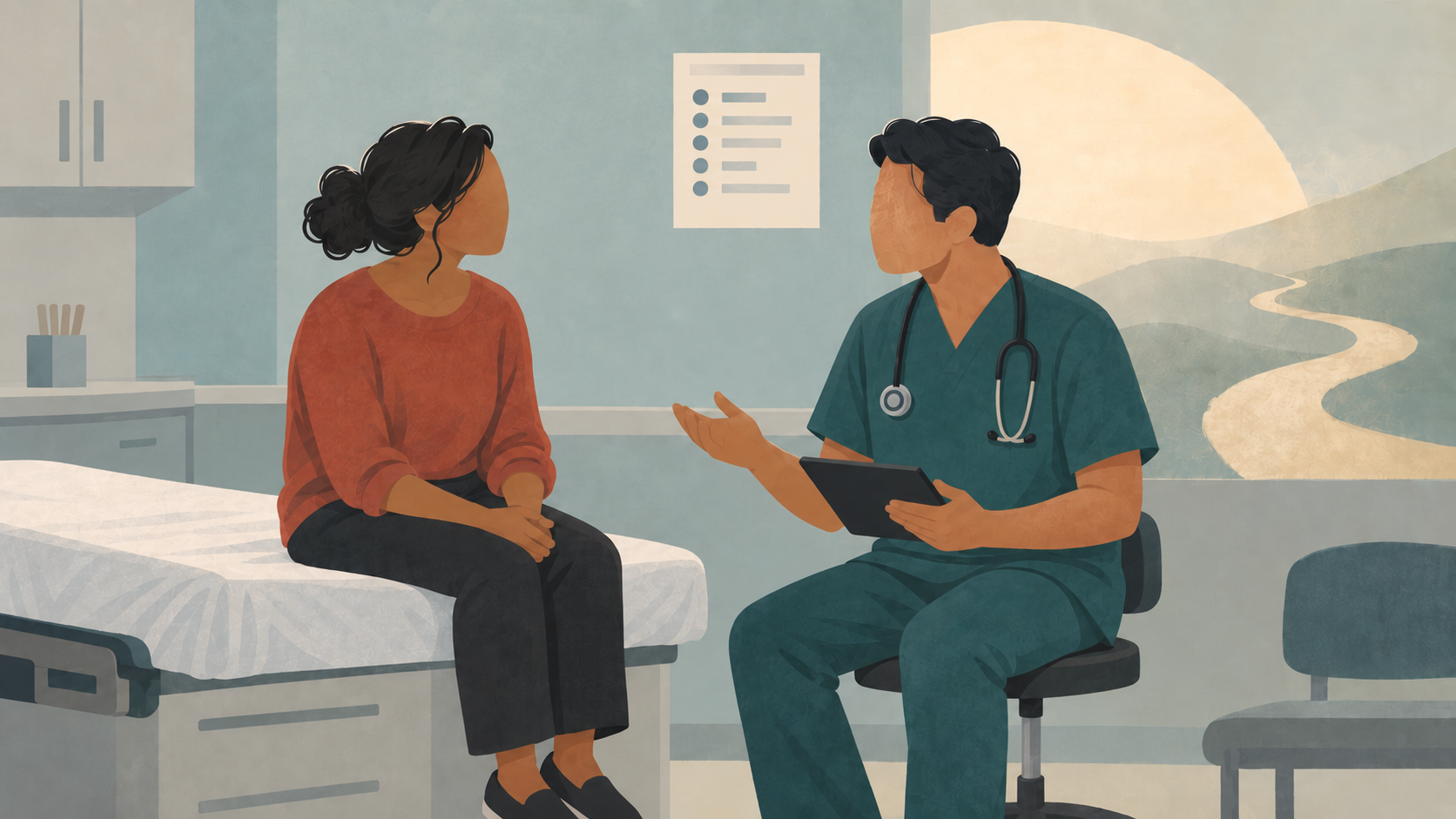
“Well, I have good news. Your labwork looks good overall and your CT scan didn’t show anything definite. I can’t say for sure what’s causing your issue, but at least we’re not seeing anything worrisome. I’d still like for you to follow up with your regular doctor in two to three days, but otherwise we can get you discharged if you’re feeling better after those medications.”
So, you’re saying there’s nothing wrong?
So you’re saying it’s all in my head?
What better way to start an article than with the conclusion?
We’re not all good at explaining to patients what’s going through our minds when we say something like the above. Part of the problem is that there is a lot going through our minds, and explaining one piece often leads to another question, and then another. That’s much of medical training—asking questions, finding answers, asking more questions, finding more answers—until you’re far enough along to say, “We looked for the dangerous causes we were most concerned about, and we didn’t find them.”
It doesn’t mean it’s all in your head, and it’s unlikely your doctor thinks you’re faking it. Perhaps a better way for us to say it is:
“Your symptoms are real. We looked for the dangerous causes we were most concerned about, and we didn’t find evidence of them. I may still not know exactly what is causing this. That doesn’t mean nothing is wrong. It means we haven’t found something that needs emergency treatment right now.”
A reassuring workup does not mean we tested for every disease that can cause your symptoms. It means the information we gathered did not point toward a dangerous condition that required more emergency evaluation or treatment at that time.
“Your workup was reassuring”
What does that mean?
Usually, it means that the pieces of your evaluation fit together in a way that makes us less worried about the dangerous possibilities we were looking for. Those pieces may include your symptoms, vital signs, physical examination, bloodwork, urine testing, an EKG, X-rays, ultrasound, CT scans, monitoring, how you responded to treatment, or simply how you looked after being observed for a period of time. Not everyone needs all of those things, and doing more tests does not automatically make an evaluation better.
What we are looking for depends on what brought you to the emergency department. If you came in with chest pain, we may be particularly concerned about a heart attack, a dangerous heart rhythm, a blood clot in the lung, or another serious problem depending on your symptoms and risk factors. If you came in with abdominal pain, the list is different. If you came in with weakness, headache, fever, dizziness, or shortness of breath, it changes again.
That is why “reassuring” does not mean, “Every possible disease was checked and every result was normal.” It means your history, examination, testing, and course in the emergency department did not give us enough reason to believe that one of the dangerous conditions we were concerned about was happening.
Sometimes a single test is very reassuring. More often, it is the combination of several things. A mildly abnormal lab result may not be concerning when everything else looks good. A normal CT scan may make some diagnoses much less likely while telling us almost nothing about others. A normal EKG and reassuring bloodwork can significantly reduce concern for a heart attack without explaining why your chest hurts.
Emergency medicine is largely about making those distinctions. We are trying to determine what needs treatment now, what needs to happen in a hospital, what can safely wait, and what needs follow-up somewhere else.
So, you don’t know what’s causing it?
Sometimes, no.
I realize that is not a very satisfying answer after spending several hours in an emergency department, getting blood drawn, having scans performed, and answering the same questions more than once. You came in because something was wrong, so leaving without a precise name for it can feel like the visit failed to accomplish its purpose.
But finding the exact cause and determining whether something dangerous is happening are not always the same problem.
Some diagnoses become obvious quickly. A broken bone may be visible on an X-ray. A kidney stone may show up clearly on CT. Certain infections, heart attacks, strokes, bowel obstructions, and many other conditions can sometimes be identified during a single emergency visit.
Other problems are not that cooperative. They may require symptoms to evolve over time. They may need testing that is not useful or appropriate in the emergency department. They may require a specialist evaluation, outpatient imaging, endoscopy, longer-term heart monitoring, repeated bloodwork, or simply a chance to see what happens over the next several days.
Sometimes the most accurate diagnosis I can give you at the end of an emergency visit is still a symptom: abdominal pain, dizziness, headache, chest pain, weakness. That can look frustratingly vague on your discharge paperwork, but putting a more specific disease name there without enough evidence would not make the diagnosis better. It would just make us sound more certain than we actually are.
That is also why follow-up matters. Your primary care clinician or specialist may be able to continue the investigation over days or weeks, when there is time to see how your symptoms change, order different tests, compare results, and look for patterns that simply cannot be seen during a few hours in the emergency department.
Uncertainty is uncomfortable. It is uncomfortable for patients, and it is not particularly comfortable for doctors either. But an honest “I don’t know exactly what is causing this yet” can still come with a useful conclusion: “I know enough at this point that I do not think you need additional emergency testing or treatment right now.”
If the tests look good, why do I still feel terrible?
Because how bad you feel and how dangerous your illness is are not the same thing.
A migraine can leave someone vomiting in a dark room, unable to tolerate light or sound, while their bloodwork and imaging are completely normal. A viral illness can make every muscle ache and leave you exhausted without causing dramatic abnormalities on testing. Musculoskeletal pain can be severe. Vertigo can make it difficult to stand. Gastritis can hurt. Dehydration can make you weak and miserable. None of those symptoms become less real because a CT scan or blood test did not provide a clear explanation.
There are also many illnesses for which emergency testing simply is not designed to provide an immediate answer. Some inflammatory, neurologic, autoimmune, hormonal, gastrointestinal, and chronic conditions require a different kind of evaluation. In some cases, there is no single test that can be ordered in the emergency department to settle the question.
And then there is time. An emergency visit gives us a snapshot. Sometimes that snapshot is enough. Sometimes an illness is still developing. An infection may be more obvious tomorrow than it is today. A rash may appear later. Pain may move. New symptoms may develop. A lab value that was normal early in an illness may change.
That does not mean everyone should stay in the hospital until every uncertainty has disappeared. If we did that, many people would spend days in the hospital waiting to see whether anything changed, and most of them would never develop anything dangerous. Instead, we use the information we have now to decide how much risk remains and what the safest next step is.
So if you still feel terrible when you leave, that does not mean the tests were pointless, and it does not mean we think the symptoms are imaginary. It may simply mean we learned something different from what you hoped to learn. We may not know exactly why you feel bad, but we may have learned that several dangerous explanations are now much less likely.
Did the tests prove I’m going to be fine?
Many patients love to ask, “So you’re saying I’m going to live?”
“Today? Yes, I expect you to live. But don’t get hit walking back to your car just to prove a point.”
There’s humor in my answer—and I promise I don’t say it to patients who are clearly distressed—but there is some truth to it as well. I don’t have a crystal ball. Neither does the CT scanner.
Medical testing changes probabilities. It rarely turns them into absolute guarantees.
If you came in with a concerning symptom and your examination, vital signs, testing, and response to treatment were reassuring, that may move a dangerous diagnosis from something we needed to investigate to something unlikely enough that additional emergency testing is no longer likely to help and may introduce harms of its own.
That does not mean the chance has become zero.
I also don’t discharge someone because I can guarantee they will not need medical care again tomorrow. Sometimes people do need to come back, and that does not automatically mean the original discharge was wrong. Diseases evolve. New symptoms appear. A person who looked safe to recover at home at 4 p.m. can develop something new at midnight.
The decision to discharge is based on what we know at that moment. We believe you are safe to continue your care outside the hospital, and we believe the next step can reasonably happen there—provided you understand what to do next and when you should come back.
What if you missed something?
We can miss things.
There is no honest way to discuss emergency medicine without saying that. A physical examination is not perfect. Blood tests are not perfect. CT scans are not perfect. Symptoms do not always follow the textbook. Some diseases look like other diseases. Some look like almost nothing at first. Sometimes the information available during the first few hours of an illness simply is not enough to reveal what is happening.
That is one reason emergency evaluations are usually layered rather than based on a single test. We start with your story and examination. We look at your vital signs and risk factors. Depending on the problem, we may add an EKG, bloodwork, imaging, monitoring, repeat testing, observation, treatment, or another examination after some time has passed. Sometimes we use well-studied clinical decision tools to help determine whether additional testing is likely to help.
Each piece changes the picture.
If I am worried about a blood clot in your lung, for example, the question is not simply whether there is one magical test that proves you do not have it. Your age, symptoms, vital signs, examination, medical history, risk factors, blood testing, and possibly imaging may all contribute to the decision. At some point, the remaining probability can become low enough that another test is more likely to create problems than to uncover a dangerous diagnosis.
That is how much of medicine works. We do not prove that bad outcomes are impossible. We gather enough information to decide what is reasonably safe to do next.
Return precautions are part of that process, not an admission that we have no idea what is happening. If I tell you to come back for worsening pain, persistent vomiting, fainting, new weakness, difficulty breathing, fever, confusion, bleeding, or whatever warning signs are relevant to your particular problem, I am telling you what new information would change the conclusion we reached today.
Likewise, follow-up is not just something we put on the paperwork because every discharge needs a follow-up box checked. Sometimes the safest plan is specifically to have someone reassess you after time has passed.
We cannot promise zero risk. What we can do is look carefully for the dangerous causes, reduce the remaining uncertainty as much as is reasonable, and give you a plan for what happens next.
So why are you sending me home?
Discharge is a medical decision.
That may sound obvious, but it is worth saying because discharge can feel very different from the patient side of the bed. You may still hurt. You may still be nauseated. You may still be dizzy, exhausted, or worried. You may still not know exactly what caused the problem that brought you in.
Being discharged does not mean you are healthy. It means we believe you do not currently need something that requires you to remain in the hospital.
That decision comes from the entire evaluation: your symptoms, examination, vital signs, test results, medical history, how your symptoms have changed, how you responded to treatment, and what we think is likely to happen next. Two people with the same symptom may reasonably have very different dispositions because the details are different.
A hospital also has a purpose. It is the right place when someone needs treatment, monitoring, procedures, repeated testing, specialist care, or another resource that cannot reasonably be provided elsewhere. Simply remaining in the hospital is not automatically safer when none of those things is needed. Hospitalization also brings its own downsides, including additional testing, medication complications, loss of sleep and mobility, and cost.
Hospitals are not places where we keep people until all of their symptoms disappear, either. A kidney stone can still hurt when someone goes home. A migraine may not be completely gone. A viral illness can make someone miserable for days. Musculoskeletal pain does not disappear because an X-ray was normal.
The question is not simply, “Do you still feel bad?” The question is whether there is a medical reason that your continued evaluation or treatment needs to happen in a hospital.
If the answer is no, then going home may be the appropriate next step even though the story is not finished. The next part may be medication, rest, hydration, primary care follow-up, specialist evaluation, additional outpatient testing, or simply watching how the symptoms change over time.
That is why your discharge instructions matter. Know what you are supposed to do next. Know what medications you should take. Know whom you are supposed to follow up with. Most importantly, know what should make you come back.
A discharge diagnosis may not be the final answer to what caused your symptoms. That is one reason I like the term “clinical impression” better than “final diagnosis.” It reflects what we think is going on based on the information we have at that moment. A reassuring workup is not a promise that nothing can change. And “we didn’t find an emergency” is not another way of saying “nothing is wrong.”
Sometimes the most important thing we can tell you after an emergency evaluation is narrower than that:
“We may not know exactly what this is yet. But based on what we know right now, we think it is safe for the next part of your care to happen outside the emergency department.”
Further reading
References
- DeGennaro AP, Gonzalez N, Peterson SM, et al. How do patients and care partners describe diagnostic uncertainty in an emergency department or urgent care setting?. AHRQ. 2024. doi: https://doi.org/10.1515/dx-2023-0085.
- Wen LS, Espinola JA, Kosowsky JM, Camargo CA Jr. Do emergency department patients receive a pathological diagnosis? A nationally-representative sample. West J Emerg Med. 2015;16(1):50-4. doi: https://doi.org/10.5811/westjem.2014.12.23474.
- Engel KG, Heisler M, Smith DM, Robinson CH, Forman JH, Ubel PA. Patient comprehension of emergency department care and instructions: are patients aware of when they do not understand?. Ann Emerg Med. 2008;53(4):454-461. doi: https://doi.org/10.1016/j.annemergmed.2008.05.016.
- Vashi A, Rhodes K. "Sign right here and you're good to go": a content analysis of audiotaped emergency department discharge instructions.. Ann Emerg Med. 2011;57(4):315-322. doi: https://doi.org/10.1016/j.annemergmed.2010.08.024.