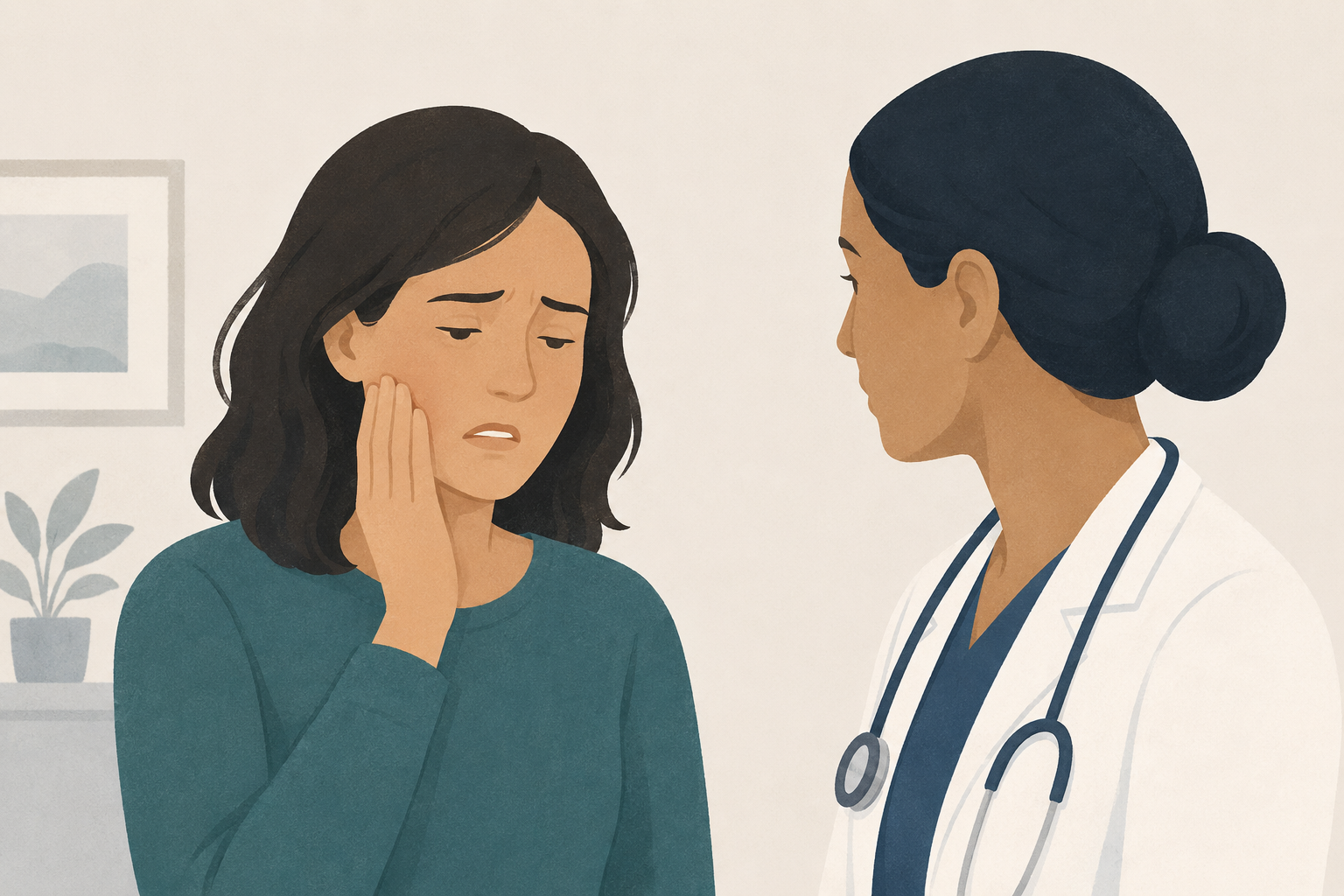
You’ve had worsening tooth pain for several days. Now there’s some swelling. You call around, but the soonest dental appointment you can get is next week. So you go to the emergency department hoping someone can fix the tooth.
The clinician examines your mouth, perhaps injects some numbing medication to relieve the pain temporarily, and may prescribe antibiotics. Then you hear the part you weren’t hoping to hear:
“You still need to see a dentist.”
What was the point of coming here?
Yes, the ER will see you for a dental problem
Dental complaints are real emergency department complaints. You can absolutely be evaluated in the ER for tooth pain, swelling, bleeding, trauma, or another problem involving your mouth. But being able to evaluate a problem is different from being equipped to definitively fix it.
Dentistry and medicine are separate professions with separate training. Physicians learn about diseases and emergencies involving the mouth, face, and neck, but medical training generally includes much less dental-specific education than dental school. Emergency physicians are not usually trained or equipped to provide comprehensive dental procedures.
That means the emergency department’s first job is often figuring out what kind of problem you actually have. Is this a cavity or an inflamed nerve inside the tooth? A localized infection? An abscess that can be drained? Facial cellulitis? An infection spreading into the face or neck? Trauma to a tooth or the jaw? Uncontrolled bleeding? A problem that threatens the airway? Or something else entirely that only feels like it’s coming from a tooth?
Why does that distinction matter? Because a bad tooth and a potentially dangerous infection can initially feel like variations of the same problem.
What can the ER do?
Depending on what is happening, the emergency department may be able to:
- examine the teeth, gums, face, jaw, and neck
- provide pain control and/or perform a dental nerve block to temporarily numb the area
- prescribe antibiotics when there is an appropriate indication
- drain some accessible abscesses
- control bleeding
- treat dehydration or other complications
- obtain imaging when a deeper infection, facial trauma, or another complication is suspected
- stabilize some dental injuries
- involve oral and maxillofacial surgery when the condition warrants it
- admit or transfer someone with a serious infection or airway threat
That can be important treatment. But none of those things necessarily fixes the tooth.
Why won’t the ER pull my tooth?
Extracting a tooth is definitive dental treatment.
Most emergency departments do not have the dental equipment, infrastructure, follow-up system, or routine expertise needed to provide tooth extractions and other comprehensive dental procedures.
There are exceptions. Some hospitals have dental clinics, dental residency programs, or oral and maxillofacial surgery services. Those hospitals may be able to provide procedures that would not be available in a typical emergency department.
But even when everyone agrees that a tooth ultimately needs to come out, that does not necessarily mean it needs to come out in the emergency department.
But if you know what’s wrong, why can’t you fix it?
Emergency clinicians diagnose and stabilize many problems whose definitive treatment happens somewhere else. A clinician may reduce and splint a broken bone, for example, while an orthopedist provides the definitive treatment later. The emergency department can treat the immediate problem without being the place where every part of the treatment is completed.
Dental care makes that division particularly frustrating because the mouth is obviously part of the body. It is reasonable to assume that a hospital would therefore have someone available to fix a tooth. But medicine and dentistry developed as largely separate systems of care. Most hospitals do not have a dentist sitting in the building waiting for emergency department consultations. That separation may not make much sense when your tooth hurts at 2 a.m., but it still determines what most emergency departments can actually provide.
When is a dental problem really an emergency?
Most isolated toothaches are not medically dangerous, even when they are extremely painful.
Dental infections can, however, spread beyond the tooth. An infection that moves into the face, beneath the jaw or tongue, or into deeper spaces of the neck can become much more serious. In severe cases, swelling can interfere with swallowing or breathing.
Emergency evaluation is particularly important for problems such as:
- rapidly increasing swelling of the face or neck
- swelling beneath the jaw or tongue
- difficulty swallowing or breathing
- difficulty handling saliva
- significant illness along with a dental infection
- swelling spreading toward the eye
- uncontrolled bleeding
- major trauma to the teeth, jaw, or face
Those are very different problems from a lost filling, a loose crown, chronic tooth sensitivity, or an uncomplicated toothache. The emergency department is designed to identify that difference.
What about a dental abscess?
The term “dental abscess” can describe problems of very different severity.
An infection may be confined around the root of a tooth. It may form a collection that can be drained. Or it may spread into the gums, face, jaw, or deeper tissues of the neck.
Some of those infections can be managed temporarily with medications. Some need drainage. Some require a root canal or tooth extraction. And some have progressed far enough that they require imaging, intravenous antibiotics, surgery, hospitalization, or transfer to another facility.
Antibiotics can be important when a dental infection has spread or is causing systemic illness, and they may be appropriate in other selected situations. But antibiotics are not automatically necessary for every toothache or every localized dental problem. Most importantly, antibiotics frequently are not the definitive treatment.
The antibiotics didn’t work
If the pain or swelling returned after you finished antibiotics, that does not automatically mean the antibiotic failed.
The underlying dental problem may simply never have been fixed.
Antibiotics can treat susceptible bacteria in tissue. They do not remove tooth decay, repair a broken tooth, treat an inflamed or dying dental pulp, or eliminate the source of many dental infections. A course of antibiotics may temporarily improve an infection while leaving the damaged tooth exactly where it was.
Once the antibiotics stop, the problem can return. That is why dental follow-up remains important even when you feel much better after leaving the emergency department.
They told me to call a dentist, but no dentist will see me
This is one of the most frustrating parts of dental care.
Access to urgent dental treatment can be terrible, especially at night, on weekends, for people without dental insurance, for patients whose insurance few local dentists accept, or in areas with limited dental services.
Being told to “see a dentist” is not particularly helpful when you have already called six of them.
Unfortunately, lack of access to dental care does not give an emergency department capabilities it does not have.
If you do not already have a dentist, possible resources vary by community but may include emergency dental practices, community health centers, dental schools, local health departments, or clinics offering reduced-cost care. Some emergency departments maintain lists of local dental resources or dentists who accept Medicaid, although those lists can become outdated quickly.
And some emergency departments simply will not have a useful referral option to give you. That is a real gap in the healthcare system. It does not mean your dental problem is unimportant.
Why didn’t the ER give me something stronger for the pain?
Dental pain can be severe. Sometimes astonishingly severe. But how badly something hurts does not necessarily tell us which medication will work best.
Much acute dental pain is driven by inflammation. For many common causes of tooth pain, anti-inflammatory medications such as ibuprofen or naproxen, when they are safe for you to take, work very well. Combining an anti-inflammatory medication with acetaminophen can provide even better relief. For most acute dental pain, these medications are generally preferred over opioids and may provide better pain relief.
That does not mean an opioid is never appropriate. There are situations where other medications cannot be used or do not provide adequate relief, and an opioid may sometimes be part of the treatment plan. But an opioid is not automatically a better pain medication simply because it sounds “stronger.”
And no pain medication fixes the underlying tooth. Whether the medication is ibuprofen, acetaminophen, an opioid, or a numbing injection, pain control is usually buying time until the dental problem can receive definitive treatment.
Before you leave
If you came to the emergency department for a dental problem, you should understand what the clinician thinks is happening and what happens next.
Ask whether antibiotics are actually indicated. Ask what you should use for pain and how to take it safely. If a nerve block was performed, ask what to expect when the numbness wears off.
You should also know how urgently you need dental follow-up and whether you need a general dentist, an oral surgeon, or another specialist.
And make sure you understand what changes should bring you back to the emergency department, especially worsening facial or neck swelling, trouble swallowing or breathing, difficulty handling saliva, or rapidly worsening illness.
The emergency department can treat the emergency around a tooth. It often cannot treat the tooth itself.
Further reading
References
- Carrasco-Labra A, Polk DE, Urquhart O, et al. Evidence-based clinical practice guideline for the pharmacologic management of acute dental pain in adolescents, adults, and older adults: a report from the American Dental Association Science and Research Institute, the University of Pittsburgh, and the University of Pennsylvania. Journal of the American Dental Association. 2024;155(2):102-117.e9.
- Lockhart PB, Tampi MP, Abt E, et al. Evidence-based clinical practice guideline on antibiotic use for the urgent management of pulpal- and periapical-related dental pain and intraoral swelling: a report from the American Dental Association. Journal of the American Dental Association. 2019;150(11):906-921.e12.
- Ferullo A, Silk H, Savageau JA. Teaching oral health in U.S. medical schools: results of a national survey. Academic Medicine. 2011;86(2):226-230. doi: https://doi.org/10.1097/ACM.0b013e3182045a51.
- Owens PL, Manski RJ, Weiss AJ. Emergency Department Visits Involving Dental Conditions, 2018. 2021. 2018.