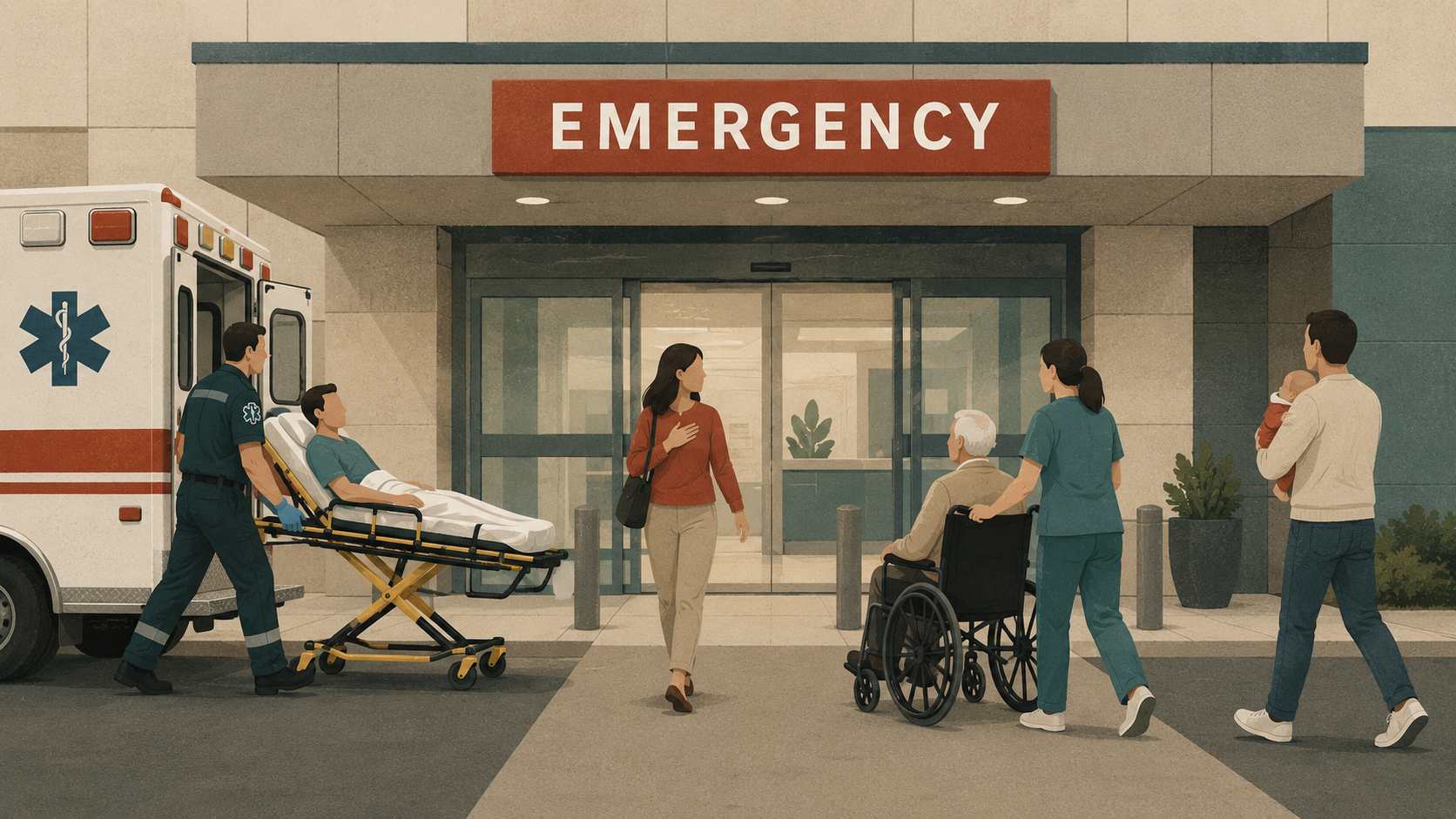
Over the course of ten minutes, five patients arrive at the same emergency department.
Patient A comes by ambulance for back pain that has been present for several weeks. He is uncomfortable, but he is alert, his vital signs are stable, and he can walk. After the ambulance crew gives its report, he is taken to the waiting room.
Patient B walks through the front door complaining of “indigestion.” She is pale and sweaty, and an electrocardiogram obtained within minutes shows a heart attack. She is taken directly to a treatment room.
Patient C arrives in a wheelchair from a clinic attached to the hospital. She became lightheaded during her appointment and briefly passed out. The clinic called a rapid response, and hospital staff brought her to the emergency department for further evaluation.
Patient D walks in carrying her two-month-old baby, who has a fever. The baby is awake and doesn’t look particularly ill, but a fever at that age can signal a dangerous infection even before a child looks sick. They are quickly taken back for an evaluation.
Patient E was visiting a family member elsewhere in the hospital when he suddenly collapsed. A code blue was called, and he arrives on a stretcher with a team already performing CPR.
All five patients entered the same emergency department. They came by ambulance, on foot, in a wheelchair, and on a hospital stretcher. Some arrived through the front entrance. Others came from elsewhere in the building. Their methods of arrival were different, but those methods did not determine who was sickest or who needed treatment first.
An ambulance is transportation, not a reservation for a treatment room. Walking through the front door doesn’t mean someone is less sick. Being brought from another part of the hospital doesn’t mean someone has already been admitted. For every patient, the emergency department must answer the same basic questions: What might be happening? Is it dangerous? What needs to be done now? And where should the next part of care occur?
What the emergency department is designed to do
Many people understandably think of the emergency department as a place where symptoms are turned into diagnoses. You arrive with pain, weakness, dizziness, vomiting, or shortness of breath. The staff performs tests, discovers the cause, treats it, and either admits you or sends you home.
Sometimes it works exactly that way. A scan shows appendicitis. An ECG shows a heart attack. An X-ray shows a broken bone. A blood test reveals dangerously low blood sugar. The problem is identified, and the next step is clear.
But that isn’t how every emergency visit ends. Emergency medicine is often less about finding the final explanation for every symptom and more about identifying immediate risk. The ED team is trying to determine whether something is threatening your life, an organ, a limb, an important bodily function, a pregnancy, or your ability to remain safe. If an emergency is present, the team begins treatment and determines whether you need admission, surgery, another procedure, psychiatric care, or transfer to another hospital.
If an emergency isn’t found, the next question is whether you can safely continue treatment or evaluation outside the hospital. That may be true even when your symptoms haven’t completely disappeared and the exact cause remains uncertain.
The emergency department’s job isn’t always to finish the entire medical story. Its job is to recognize what cannot safely wait, stabilize what requires immediate treatment, and determine where the next part of care belongs.
What counts as an emergency?
People often describe an emergency as a threat to “life or limb.” That is useful shorthand, but it is incomplete. Emergency care also protects organs, vision, brain function, circulation, speech, movement, pregnancy, mental status, and the ability to remain safe.
A stroke may not initially threaten to kill someone, but delayed treatment can result in permanent loss of speech, strength, coordination, or independence. A blocked artery in a leg can lead to tissue death and amputation. Sudden loss of vision may become permanent without prompt treatment. Pressure on the spinal cord can cause lasting weakness or loss of bladder control. Severe confusion, also called delirium, may signal a dangerous illness and leave someone unable to protect themselves.
Mental health emergencies belong in the same discussion. A person with suicidal intent, severe psychosis, dangerous agitation, or an inability to care for basic needs may face an immediate threat to life or safety even without a visible physical injury.
A practical definition is that an emergency is a medical condition, injury, psychiatric crisis, pregnancy-related problem, or other situation in which delay could reasonably result in death, serious worsening of health, loss of an organ or limb, impaired bodily function, or an inability to remain safe.
The diagnosis doesn’t have to be confirmed before the situation deserves emergency evaluation. Chest discomfort may or may not be a heart attack. One-sided weakness may or may not be a stroke. Abdominal pain may or may not be appendicitis, an ectopic pregnancy, a bowel obstruction, or internal bleeding. Sudden confusion may or may not be caused by infection, stroke, low blood sugar, medication toxicity, or another dangerous problem.
Most patients evaluated for a particular emergency will turn out not to have it. That doesn’t mean the evaluation was unnecessary. The consequences of missing the dangerous possibility may be far greater than the consequences of looking for it.
Doctors sometimes divide emergencies into “medical” and “surgical” conditions. Medical emergencies are treated mainly with medication, monitoring, or supportive care. Surgical emergencies may require an urgent operation or procedure. In practice, many emergencies require both. For the patient, the more important question is not which category the problem falls into, but what harm could occur if treatment is delayed.
Acute and chronic describe time, not danger
Medical language can make these distinctions more confusing. “Acute” generally means new, recent, sudden, or occurring over a relatively short period. It describes timing, not severity.
A sore throat that began this morning is acute. So is a stroke that began ten minutes ago. One may be minor and the other catastrophic. The word “acute” alone doesn’t tell you which.
“Chronic” generally means longstanding, persistent, or recurrent over months or years. It also describes timing rather than danger. Chronic heart failure, kidney disease, lung disease, depression, pain, and cancer can all become life-threatening. Chronic doesn’t mean imaginary, unimportant, or safe.
A chronic problem can also develop an acute complication. Someone with years of back pain may need emergency evaluation when the pain is suddenly accompanied by leg weakness or loss of bladder control. Someone with chronic lung disease may develop severe respiratory distress. Someone with longstanding depression may develop suicidal intent. A patient receiving cancer treatment may develop a fever that signals a dangerous infection.
Emergency departments generally aren’t designed to manage stable, unchanged chronic conditions. They do, however, evaluate new symptoms and acute worsening in patients with chronic illness.
“Acute” describes when something began or changed. “Emergency” describes the risk created by waiting.
What happens after you arrive?
Triage is usually one of the first steps. It helps determine how urgently someone appears to need care and how patients should be prioritized when many people need attention at once. Triage isn’t the complete emergency evaluation, and it isn’t a final diagnosis.
The broader evaluation is sometimes called the medical screening examination. Despite the name, this isn’t simply a quick look to decide whether someone seems sick enough to stay. It is the evaluation needed to determine whether an emergency medical condition exists.
Its extent depends on the symptoms, vital signs, examination, risk factors, and the hospital’s capabilities. For one patient, a history and physical examination may answer the emergency question. For another, the process may include an ECG, blood tests, imaging, medication, observation, consultation, repeat vital signs, or several examinations over time.
This is why a patient may have blood drawn, an ECG performed, imaging ordered, or medication given while still in the waiting room. The emergency evaluation may already be underway even though the patient hasn’t entered a traditional treatment room.
A medical screening examination doesn’t guarantee a particular test, a complete workup for every possible diagnosis, or a final explanation for every symptom. It is intended to determine whether an emergency medical condition exists and what needs to happen next.
The law behind emergency screening
A federal law called the Emergency Medical Treatment and Labor Act, usually shortened to EMTALA, applies to Medicare-participating hospitals that operate emergency departments. That includes most hospital emergency departments in the United States.
In general, these hospitals must provide an appropriate medical screening examination when someone comes to the emergency department requesting evaluation or treatment. If an emergency medical condition is found, the hospital must provide stabilizing treatment within its capabilities or arrange an appropriate transfer when the needed care isn’t available there. The hospital may not delay the screening examination or necessary stabilizing treatment to determine insurance coverage or ability to pay.
EMTALA is important, but it is often misunderstood. It doesn’t require the ED to order every test a patient requests, provide a final diagnosis, admit everyone whose symptoms continue, or make every symptom disappear before discharge. It also doesn’t make emergency care free. The law protects access to emergency screening and stabilizing care; it doesn’t require one emergency visit to complete every part of a person’s medical care.
The emergency department as the healthcare system’s safety net
The emergency department also has a role that extends beyond the formal definition of an emergency. It is the healthcare system’s safety net.
The ED is open at night, on weekends, and on holidays. It evaluates people who don’t have a primary-care clinician, can’t obtain a timely appointment, lack insurance, or need services that a clinic or urgent care can’t provide. It receives patients when mental health services are unavailable, when a caregiver can no longer manage someone safely at home, when a critical medication has run out, or when another facility lacks the necessary equipment or expertise.
These are real needs. A problem doesn’t become unimportant simply because it isn’t an emergency. A patient without housing still needs help. A family struggling to care for an older relative may be in crisis. Someone seeking treatment for substance use may genuinely be ready for help. A patient with months of unexplained symptoms may be frightened and may have been unable to access outpatient care.
The emergency department may be the only open door, but it isn’t equipped to be every room in the healthcare system.
It can evaluate immediate danger, stabilize acute illness, provide short-term treatment, involve social work or case management, arrange a transfer, and offer referrals or community resources. It may be able to replace a critical medication temporarily or clarify how quickly follow-up is needed.
But it cannot always establish long-term primary care, guarantee a specialist appointment, complete a diagnostic process that normally unfolds over months, secure permanent housing, arrange immediate nursing-home placement, replace ongoing mental health or substance-use treatment, or repair the access problem that brought someone to the ED.
Sometimes an outpatient plan is medically appropriate but extraordinarily difficult for a patient to carry out. That is a genuine weakness of the healthcare system. Emergency clinicians may try to bridge the gap, but they can’t always close it.
Deciding where care belongs
Emergency clinicians are trained not only to recognize illness, but also to determine what must be done in a hospital and what can be handled safely elsewhere.
Hospital care is generally appropriate when a patient needs something that can’t be provided safely at home or in an outpatient setting. That may include continuous monitoring, repeated intravenous treatment, breathing support, emergency surgery, treatment for organ failure, frequent reassessment because deterioration is likely, psychiatric containment for immediate danger, or specialist intervention that cannot safely wait.
Other problems are better evaluated over time. Longstanding fatigue, possible vitamin deficiencies, hormonal concerns, autoimmune disease, chronic joint pain, gradual medication adjustments, routine cancer screening, and many unexplained symptoms may require a detailed review of prior records, testing performed in stages, comparison of trends, treatment trials, and repeated examinations.
Outpatient care isn’t a lesser form of care. In many cases, it is better suited to answer the question. A primary-care clinician can review years of history, see how symptoms change, compare laboratory results over time, adjust medications gradually, coordinate specialists, follow incidental findings, and reconsider the diagnosis as new information develops.
Some medical questions are answered not by more urgent testing, but by time, continuity, and repeated evaluation.
“If you aren’t sure what’s wrong, why am I being discharged?”
A patient comes to the ED with abdominal pain. Blood tests are reassuring. A CT scan doesn’t show appendicitis, bowel obstruction, internal bleeding, or another condition requiring immediate treatment. The patient still has pain, and the emergency physician can’t say with certainty what is causing it.
To the patient, discharge can sound like this: “We don’t know what’s wrong, but we’re sending you home anyway.”
What the clinician may be trying to communicate is:
“While we’re not sure what’s causing your pain, your examination and workup are reassuring that there isn’t an emergency today. However, if your pain were to get significantly worse, or you have other new symptoms that worry you, we’d ask that you return to the ED for a new evaluation.”
A final diagnosis and a safe disposition aren’t the same thing. The physician may not know the exact cause of abdominal pain, dizziness, headache, fatigue, numbness, back pain, vomiting, or shortness of breath. The physician may still be able to determine that the vital signs are stable, the examination is reassuring, testing hasn’t shown a condition requiring emergency intervention, and continued hospital care is unlikely to provide a meaningful benefit.
An emergency evaluation is also a snapshot in time. Some illnesses become easier to recognize as they evolve. A reassuring examination, scan, or blood test today can’t guarantee that symptoms won’t change tomorrow. That is why discharge instructions include reasons to return.
Returning later doesn’t necessarily mean the first evaluation was wrong. A changed condition deserves a new evaluation, and the information available tomorrow may be different from the information available today.
Emergency medicine doesn’t always answer, “What is the final diagnosis?” Sometimes it answers, “What dangerous conditions have been reasonably addressed, and what is the safest next step?”
“I still have pain. Why am I being discharged?”
Pain matters, and treating it is an important part of emergency care. But eliminating all pain isn’t always possible, and it isn’t always required before discharge.
A broken bone may still hurt after it has been aligned and splinted. A kidney stone may still cause discomfort after the pain has improved enough to be managed at home. A migraine may be substantially better without being completely gone. A sprain, viral illness, muscle strain, or episode of nonsurgical abdominal pain may continue to cause symptoms for days.
The ED team considers whether the pain is improving, whether the patient can walk, breathe, drink, urinate, sleep, or care for themselves, and whether the symptoms are likely to represent a condition requiring hospital treatment. The team also considers whether admission would provide something useful that can’t be provided at home.
Persistent pain doesn’t mean the pain is unimportant. It also doesn’t, by itself, mean that more testing, stronger medication, or hospital admission will improve the outcome. A patient may remain uncomfortable but still be medically stable, able to function, and unlikely to benefit from continued hospital care.
The decision to discharge isn’t necessarily a statement that nothing is wrong. It is a judgment that the patient doesn’t currently need the resources of the hospital.
Important doesn’t always mean inpatient
Some problems remain important and time-sensitive after the emergency evaluation is complete. A stable fracture may need orthopedic follow-up. An infection may require oral antibiotics and reassessment. A suspicious imaging finding may require prompt evaluation by a specialist. A patient with a kidney stone may need urology follow-up.
These problems may be urgent without requiring continued ED treatment or hospital admission. Discharge doesn’t mean unimportant.
Cancer is one of the most difficult examples. Cancer can cause true emergencies. A tumor may obstruct an airway or intestine, compress the spinal cord, cause severe bleeding, weaken a bone until it fractures, or produce a dangerous infection or metabolic disturbance. Those complications may require immediate hospital treatment.
But the possibility of cancer isn’t always itself an emergency. A suspicious mass, unexplained weight loss, chronic anemia, or incidental lesion on a scan may need prompt and careful follow-up without requiring admission or a complete cancer evaluation in the ED. Biopsies, specialized imaging, consultation, and treatment planning are usually better coordinated through outpatient care.
That doesn’t make the concern less frightening or less important. It means the next part of the evaluation requires time, continuity, and expertise that an emergency admission may not provide.
What an emergency visit can lead to
An emergency visit doesn’t have one correct ending. Some patients are discharged with medication, follow-up, and instructions about when to return. Some remain for observation and repeat testing. Some are admitted to the hospital. Others need emergency surgery, psychiatric evaluation, or transfer to a facility with specialists or equipment that the first hospital doesn’t have.
Each outcome reflects the same basic decision: What is the safest and most appropriate setting for the next part of this patient’s care?
Sometimes the ED finds a clear diagnosis and begins definitive treatment. Sometimes it treats symptoms and narrows the dangerous possibilities without finding one final answer. Sometimes it identifies an important problem that belongs in primary or specialty care. And sometimes it recognizes that the healthcare system has left a patient with nowhere else to turn, even though the ED cannot provide the complete solution.
The purpose of the emergency department is not to solve every medical problem in a single visit. It is to identify immediate danger, treat what cannot wait, and help determine what should happen next.
Further reading
- “Still in the waiting room” doesn’t mean “still waiting for care” — Emergency Room Explained
- Recognizing Medical Emergencies — MedlinePlus
- When to use the emergency room - adult — MedlinePlus
- Emergency Room Guide — HealthEd for Everyone
- You Have Rights in an Emergency Room Under EMTALA — Centers for Medicare & Medicaid Services
References
- American College of Emergency Physicians and Emergency Nurses Association.Emergency Department Triage. Joint policy statement. Approved January 2025.
- Centers for Medicare & Medicaid Services.Emergency Medical Treatment & Labor Act (EMTALA). Updated March 10, 2026.
- United States Code. 42 U.S.C. § 1395dd.Examination and Treatment for Emergency Medical Conditions and Women in Labor.
- Yun BJ, Singh MK, Reznek MA, et al.Strengthening Essential Emergency Departments: Transforming the Safety Net. Health Affairs Scholar. 2025;3(3):qxaf044.